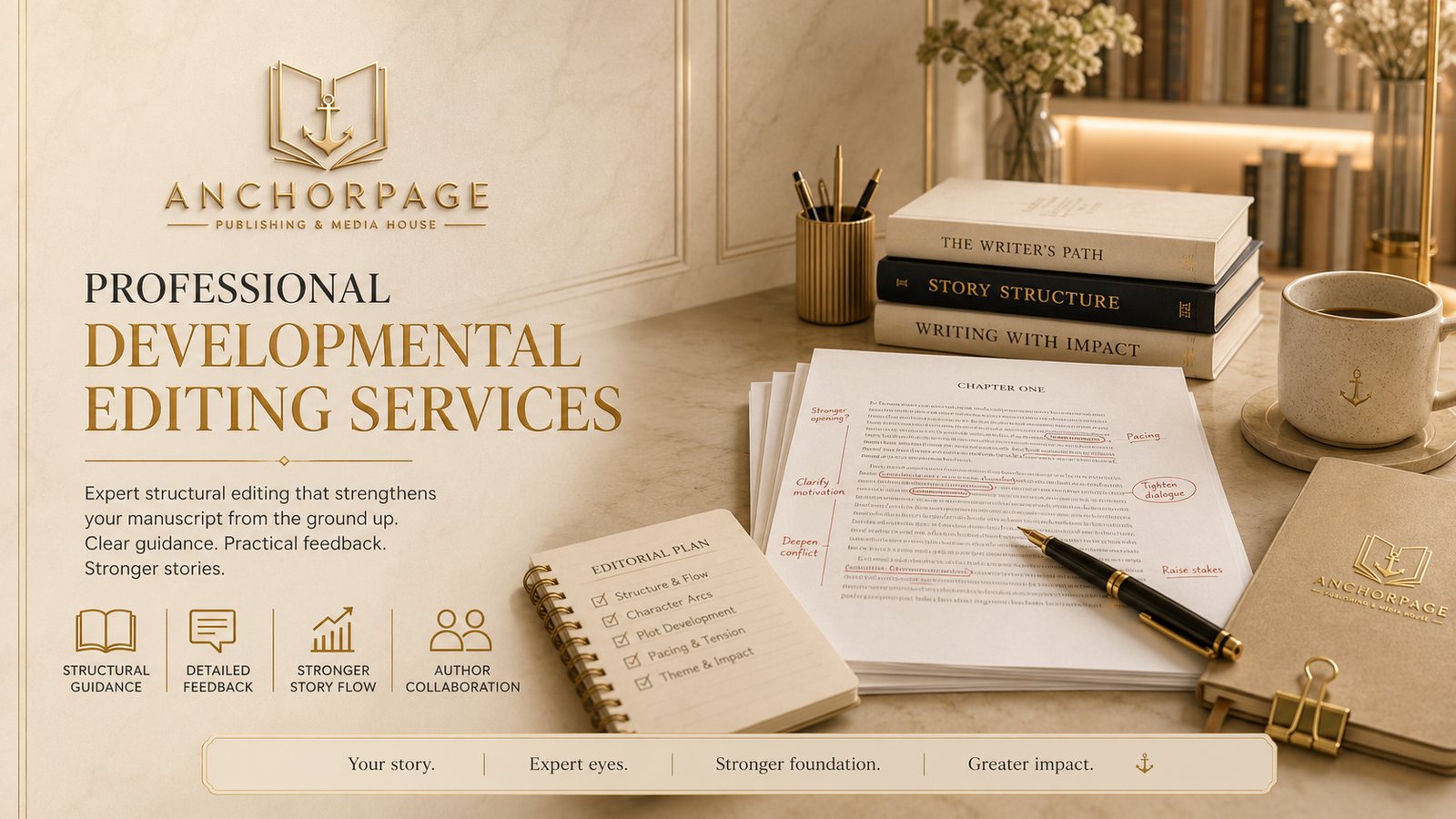
AnchorPage provides professional developmental editing services for authors who need detailed support improving the structure, direction and overall effectiveness of a manuscript.
Developmental editing goes beyond grammar and spelling. It examines the book as a complete work and helps strengthen its organisation, argument, narrative flow, pacing, clarity and reader experience.
As a UK-based publishing and media house serving the Middle East and international clients, we work closely with authors to develop stronger, more coherent manuscripts before copyediting, proofreading and publication.
What Is Developmental Editing?
Developmental editing is an in-depth editorial process focused on the content and structure of a manuscript.
The editor reviews how the book is organised, whether the ideas or story develop effectively and whether each chapter contributes meaningfully to the whole.
Depending on the project, developmental editing may include recommendations, comments within the manuscript, restructuring guidance and direct revisions.
Who Our Professional Developmental Editing Services Are For
Our professional developmental editing services are suitable for:
- First-time and established authors
- Founders and executives writing business books
- Memoir and biography authors
- Experts developing educational books
- Writers with incomplete or early-stage manuscripts
- Authors who have received a manuscript review
- Organisations developing editorial publications
What Developmental Editing Covers
Book Structure
We assess the overall organisation of the manuscript and whether the chapters appear in the most effective order.
Where necessary, we may recommend moving, combining, shortening or expanding sections.
Narrative Flow and Pacing
For memoirs, biographies and narrative books, we review how the story progresses and whether the pacing keeps the reader engaged.
We identify sections that feel rushed, repetitive, disconnected or unnecessarily slow.
Argument and Idea Development
For business, leadership, educational and thought-leadership books, we assess whether the central ideas are clear, supported and logically developed.
We identify gaps, repetition, unsupported claims and areas requiring stronger examples or explanation.
Voice and Tone
We review whether the author’s voice remains clear and consistent throughout the manuscript.
The tone should suit the subject, audience and purpose of the book without losing the author’s personality.
Chapter Purpose and Balance
Every chapter should have a clear role within the book.
We evaluate whether chapters are balanced in length, depth and relevance and whether each section moves the manuscript forward.
Character and Emotional Development
For memoirs, biographies and narrative projects, we assess character development, emotional depth, reflection and the relationship between events and meaning.
Audience and Positioning
We consider whether the manuscript speaks clearly to its intended readers and supports the author’s wider goals.
This can include recommendations on positioning, messaging and areas that may need greater accessibility.
What You Receive
The scope of developmental editing depends on the manuscript and project requirements.
It can include:
- Detailed editorial comments
- Structural recommendations
- Chapter-level feedback
- Suggested reorganisation
- Guidance on missing or unnecessary content
- Notes on voice, tone and clarity
- Direct manuscript revisions where agreed
- Recommendations for the next editorial stage
Our Developmental Editing Process
Initial Manuscript Assessment
We begin by reviewing the manuscript, intended audience and the author’s main objectives.
This helps us define the appropriate level of editorial support.
Editorial Plan
We identify the main structural and content priorities and establish how the manuscript will be reviewed.
Detailed Editing
The editor works through the manuscript, providing comments, recommendations and revisions according to the agreed scope.
Author Review
The author reviews the editorial feedback, responds to questions and makes decisions about the recommended changes.
Revision and Final Direction
Where included, the editor reviews revised material and provides final guidance before the manuscript moves to copyediting or proofreading.
Developmental Editing Versus Copyediting
Developmental editing focuses on the larger structure, content and direction of the manuscript.
Copyediting focuses more closely on language, grammar, consistency, sentence clarity and style.
A manuscript should normally complete its major structural changes before detailed copyediting begins.
Collaborative and Respectful Editing
Developmental editing should strengthen the manuscript without replacing the author’s voice.
Our approach is collaborative, practical and respectful. We explain why changes are recommended and help the author make informed decisions about the book.
The author remains in control of the manuscript and its final direction.
Develop a Stronger Manuscript
Professional developmental editing services can help transform a promising draft into a clearer, stronger and more engaging book.
Contact AnchorPage to discuss our professional developmental editing services and determine the right next step for your manuscript.
Many authors begin with a manuscript review before deciding whether they need developmental editing, copyediting or proofreading.
AnchorPage can support the project with interior formatting, publishing services setup, private printing, distribution and launch media.